Download
Jeux d'orgues 4 - La Chaise Dieu
For Hauptwerk 4 or higher, and GrandOrgue.
Download size: 3.8 Go
Original + Extended
Stereo 24 bit (Wet)
Your contribution supports the digitization of these instruments. A standard or generous contribution gives you access to the same content.


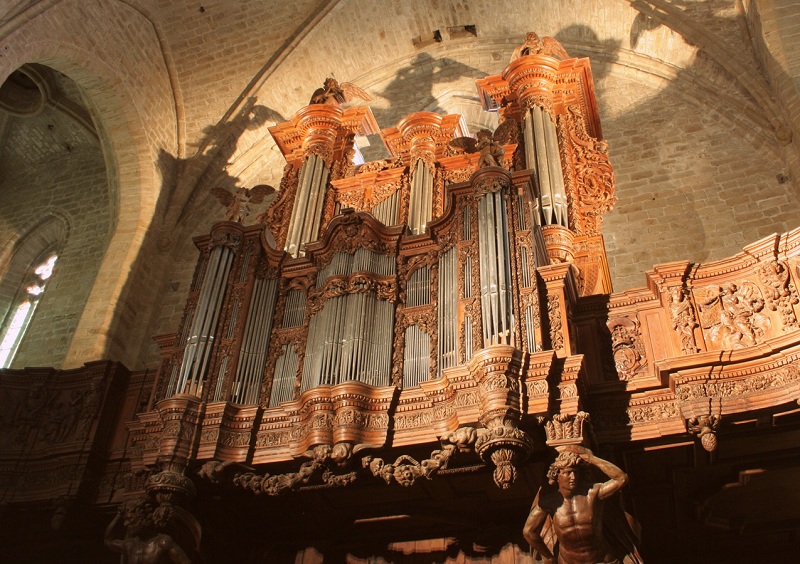
 The archives of the abbey mention the construction of an organ in 1683. It is the "small case" that still exists today. We do not know who was the organ builder of this first construction. Hyacinthe Serroni, then commendatory abbot of La Chaise-Dieu, was a great and sumptuous lord who arrived at the French court in the entourage of Cardinal Mazarin. He undoubtedly wanted La Chaise Dieu to have a sumptuous decor, as cherished by the Italians of the Baroque period. The organ loft is signed by the sculptor Jean-Pierre Cox (1653-1723), born in Antwerp, but is in line with the decorative logic of the French Baroque.
We know little about the sound structure of this instrument limited to the 14 stops of the Positif. It was not finished, probably due to the bankruptcy of the abbot, who died in 1687.
 The new pipework takes place in the large case, in a style quite different from that of the 1683 Positif. Marin Carouge did not seek the homothety of the organ cases, contrary to what is usually practiced. In fact, the large organ case is probably a recovery of another organ. It is worth noting the statues of musical angels at the top of the large turrets. It is a work of great quality, anonymous but very similar to what Vaneau and his entourage were doing in Le Puy at the same time.
During the XVIIIth century, we can identify two interventions by organ builders. In 1779, J. Prades, from the town of Sommières in Bas-Languedoc, carried out work that is difficult to evaluate. But above all, at the end of the 18th century, the windchest of the positive was changed. Instead of the old 48-note windchest (from 1683?), a 50-note windchest was installed, probably an old great organ windchest.
 The organ of La Chaise-Dieu is the very type of the French classical organ. It has 40 ranks, 4 manual keyboards (positif, grand orgue, récit and écho), like Marin Carouge's original instrument. The pedalboard is typical of the French style, with its "grand ravalement" starting a F0.
The abbey benefits from pleasant acoustics, due to the tapestries which prevent too strong reverberation. It was therefore necessary to give the instrument more power and brilliance, without it becoming shrill. Michel Garnier showed exceptional talents as a harmonist and everyone can taste the richness and breadth of the great reed choir.
The privileged repertoire is obviously the French organ school of the 17th and 18th centuries: Boyvin, Couperin, Grigny, Corrette, Dandrieu, etc. but also Bach or the German repertoire (for example, with the "Extended" version).
 "Extended" version: